

في هذا المقال
Here is the full English version of the article, formatted and ready to publish:
# The AIEarthquake and the Job Market: The Ultimate Guide to Survival and Dominance in the Age of the Machine![]()
## Introduction: A New Reality Waking Up the World
Imagine waking up tomorrow morning to find that tasks requiring a full week of grueling work and deep focus can now be completed in seconds with the click of a button. This scenario is no longer science fiction—it is our daily reality. The world is experiencing an unprecedented revolution that targets human cognitive abilities, critical thinking, and creativity rather than manual labor or physical exertion.
Artificial Intelligence (AI) is not a passing trend or a simple digital assistant; it is a fundamental shift reshaping the economic and social foundations of the job market. The question echoing through corporate boardrooms, universities, and homes today is no longer: *"Will AI affect my job?"* but rather: **"How can I adapt to this technological earthquake before I am pushed out of the equation entirely?"**
This comprehensive guide breaks down the dimensions of this revolution, explores high-risk versus thriving professions, and outlines a practical strategy to make your skill set irreplacable.
---
## Chapter 1: How Did We Get Here? (A Historical Comparison of Industrial Revolutions)
To understand the scale of current changes, we must look back at history. When James Watt invented the steam engine in the 18th century, manual laborers feared losing their livelihoods. While certain jobs vanished, the shift ultimately created millions of new roles in factories, assembly lines, and logistics.
A similar pattern occurred with electricity, computers, and the internet. Each technological leap ultimately raised living standards and boosted overall human productivity. So why is AI causing such widespread alarm today?
The answer lies in **four core factors**:
1. **Exponential Rate of Adoption:** Historical technology transfers took decades, giving generations time to reskill. AI evolves exponentially—reaching millions of users in days, with major technical updates released weekly instead of annually.
2. **Targeting Cognitive Skills:** Older machines replaced physical effort. Today's AI targets tasks once thought to be uniquely human: data analysis, coding, medical diagnostics, copywriting, and artistic creation.
3. **Self-Learning Capabilities:** Modern systems do not rely solely on pre-programmed instructions; they learn from mistakes, process massive datasets, and self-improve without direct human intervention.
4. **Economic Scalability:** The cost of running an AI algorithm to perform tasks previously handled by dozens of employees is a fraction of the cost of salaries, insurance, and benefits, making routine automation financially compelling for businesses.
---
## Chapter 2: Sector-by-Sector Job Breakdown
AI does not eliminate jobs wholesale; instead, it redistributes the value of specific skills across three main categories:
### Category 1: High-Risk Professions (Direct Automation)
Jobs defined by repetitive patterns and fixed rules can be performed faster and with fewer errors by algorithms:
* **Data Entry & Administrative Processing:** Intelligent software can process invoices, clean spreadsheets, and update databases with zero human error.
* **Tier-1 Customer Support:** AI chatbots now handle routine customer inquiries in dozens of languages around the clock.
* **Basic Translation & Standard Copywriting:** Neural-machine translation tools provide fast, accurate translations for general text, news updates, and basic reports.
* **Routine Bookkeeping & Auditing:** Financial software easily reviews transaction logs, balances ledgers, and checks for regulatory compliance automatically.
### Category 2: Transformative Sectors (AI-Augmented Roles)
These fields will not disappear, but their daily operations will be completely redefined:
* **Healthcare & Diagnostics:** AI scans X-rays and lab tests with extreme precision, predicting health risks before symptoms appear. This allows medical professionals to shift their focus toward patient care, complex treatment strategies, and emotional support.
* **Legal Services:** Large language models analyze thousands of legal documents and case histories in minutes. Paralegals can skip manual research to focus on strategic defense planning and client representation.
* **Software Development:** AI writes basic code and flags bugs instantaneously. Developers are evolving from code writers into software architects who design system frameworks, oversee logic, and ensure security.
* **Marketing & Media:** Idea generation, initial drafting, and campaign data analysis are offloaded to technology, leaving human professionals to focus on creative strategy, cultural nuances, and brand voice.
### Category 3: Future-Proof Professions (The Safe Havens)
These roles rely on deeply human traits that machines cannot replicate in the foreseeable future:
* **High-Empathy Roles:** Psychotherapists, social workers, and specialized caregivers who provide genuine human connection and emotional support.
* **Strategic Decision-Makers:** C-suite executives, policy makers, and judges who weigh complex legal frameworks alongside ethics, morale, and social context.
* **Complex Physical & Field Crafts:** Plumbers, electricians, and technicians operating in unpredictable physical environments requiring real-time spatial adaptability.
* **Theoretical Researchers & Innovators:** Scientists and thinkers who invent entirely new concepts, challenge existing paradigms, and build hypotheses beyond current training data.
---
## Chapter 3: Ethical, Legal, and Intellectual Property Challenges
A complete understanding of AI in the workforce requires addressing several pressing ethical and legal issues:
* **Intellectual Property Rights:** When an AI model generates artwork or text derived from training data containing millions of human-created works, ownership remains contentious. Courts worldwide are currently debating whether rights belong to model developers, prompt engineers, or original creators.
* **Algorithmic Bias:** AI systems reflect the datasets used to train them. If historical data contains biases, algorithms risk perpetuating discrimination in hiring practices, credit scoring, or predictive policing.
* **Liability & Accountability:** When an AI-driven medical tool misdiagnoses a condition or an autonomous vehicle causes an accident, establishing clear legal responsibility—among developers, manufacturers, or operators—remains a major regulatory challenge.
---
## Chapter 4: Key Tools Reshaping the Modern Workplace
Understanding how AI integrates into daily workflows requires examining the tools currently driving efficiency gains:
* **Large Language Models (e.g., ChatGPT, Claude, Gemini):** Utilized for summarizing lengthy documents, drafting communications, editing content, generating code, and research.
* **Generative Image & Design Tools (e.g., Midjourney, DALL-E):** Employed by designers to produce mood boards, concept art, and visual assets rapidly.
* **Embedded AI Productivity Suites (e.g., Copilot, Workspace AI):** Integrated into standard text editors and spreadsheets to convert raw financial data into visual dashboards via natural language prompts.
* **Intelligent Coding Assistants (e.g., GitHub Copilot):** Functions as a real-time pair programmer, autocompleting functions and detecting syntax issues during development.
---
## Chapter 5: Real-World Case Studies – Adapt vs. Fail
### Case Study 1: The Media Publisher
An online news outlet laid off 30% of its writing staff in favor of fully automated AI content generation. The result was a sharp drop in content quality, factual errors, and reputational damage. The publisher eventually rehired human professionals under a new title: **"AI Content Editors and Fact-Checkers."**
### Case Study 2: The Digital Marketing Agency
Rather than cutting staff, a digital agency trained its creative team on advanced generative AI tools. Overall agency output increased by 400% without increasing working hours. Employees redirected freed-up time toward client relationships, high-level strategy, and original campaign concepts.
-- Chapter 6: A 5-Point Strategy for Career Resilience
Fear and avoidance will not stop technological progress. The most effective approach is an active strategy centered on continuous adaptation:
```
┌─────────────────────────────────────────────────────────┐
│ Future-Proof Career Roadmap │
├─────────────────────────────────────────────────────────┤
│ 1. Commit to Lifelong Learning │
│ 2. Develop a T-Shaped Skill Profile │
│ 3. Double Down on Human-Centric Soft Skills │
│ 4. Master Prompt Engineering & AI Workflows │
│ 5. Build a Strong Personal Brand │
└─────────────────────────────────────────────────────────┘
```
1. **Commit to Lifelong Learning:** The concept of relying on a single degree for a 40-year career is obsolete. Set aside dedicated time weekly to test new digital tools and stay informed on industry shifts.
2. **Develop T-Shaped Skills:** Combine deep expertise in one specific domain (the vertical bar) with broad knowledge across adjacent fields like marketing, technology, and psychology (the horizontal bar).
3. **Focus on Uniquely Human Soft Skills:** Prioritize critical thinking, ethical reasoning, complex problem-solving, and emotional intelligence—traits algorithms cannot simulate.
4. **Master Prompt Engineering:** Learn to use AI effectively as a brainstorming partner, research assistant, editor, and outline generator to accelerate your output.
5. **Build a Personal Brand:** As generic digital content becomes abundant, trust, reputation, and personal credibility become premium assets.
---
Conclusion: The Future Belongs to the Adaptable
Artificial Intelligence is not a threat designed to wipe out human effort; it is a mirror reflecting our capacity to evolve. History demonstrates that technology redefines work rather than ending it, and meaningful transformation happens in how humans utilize new tools.
The defining dynamic of the future economy can be summarized simply:
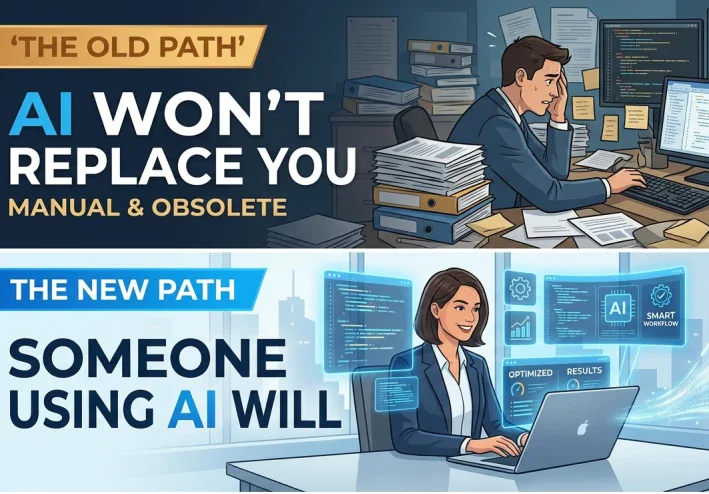
> **"AI will not replace humans, but humans using AI will inevitably replace humans who refuse to adapt."**
The choice remains yours: remain passive in the face of change, or take the initiative to master these new tools and lead in the workplace of tomorrow.
تابع جديد Rawan
اختر إشعارات الموقع أو البريد أو الاثنين. الزائر يقدر يشترك ببريده دون تسجيل حساب.
الإبلاغ عن المقال
لو لاحظت مشكلة في المحتوى، أرسلها لفريق المراجعة. لن تظهر بياناتك لكاتب المقال أو للقراء.
تعذّر إرسال البلاغ الآن. حاول مرة أخرى لاحقًا.
سجّل الدخول لإرسال بلاغ
النقاش
التعليقات (0)
فكرة تضيفها، أو سؤال يفتح حوارًا.
الرجاء تسجيل الدخول لتتمكن من التعليق